UK Padel players
There are now more than one million players in UK, and that number continues to rise. Clubs and operators need to take a proactive approach to finding good Padel court supplies to ensure they have minimal downtime.
 The most vulnerable part of a Padel court, which is the most likely to lead to court downtime, are the glazed panels. These are subsequently the most important element of your Padel court supplies to get right.
For every hour that a Padel court isn’t in use, it costs the operator/club money. It also encourages players to find an alternative court to play on, making them less likely to return to their original club.
It’s therefore essential to understand what the court downtime risk factors might be when buying structural Padel court supplies.
Key Takeaways
- Padel court suppliers based outside of the UK often sell products that aren’t designed for the UK climate and can be made with lower quality materials
- A low-carbon supply chain can often be a deciding factor in securing planning applications for new Padel courts
- Padel court glass that has been heat soaked (a process which check for impurities) is less likely to break
Sourcing durable Padel court supplies and kits
At present, most operators and clubs get their Padel court supplies imported from Spain or China as a complete kit. In the short term this can be the most cost-effective way to buy your Padel court supplies, especially when setting up new courts, but there are two key quality issues that clubs and operators should be aware of before making a purchase.
- Vibration – Cheap kits often use thinner steel frames or lower-grade anchoring systems. This means that when a ball hits a glazed panel, the whole Padel court’s fencing structure vibrates, creating a noticeable shuddering noise. This makes the court appear low-grade. It also puts the glazed components being held by the frame under additional stress, making them more likely to break.
- Corrosion – As Padel is incredibly popular in Spain, many court kits are designed for the Mediterranean climate. Subsequently, many of the steel structures don’t have the anti-corrosion coatings needed for the UK’s wet weather. Rust can start to appear within less than two years. This also causes metal expansion which changes the amount of pressure on the glazed panels, which can lead to a breakage. Subsequently, when buying Padel court supplies that relate to a court’s structure, it is essential that they have anti-corrosive coatings.
Glazed Padel court components
Given the nature of the sport, there will constantly be balls rebounding, rackets hitting and people falling against a Padel court’s enclosure.
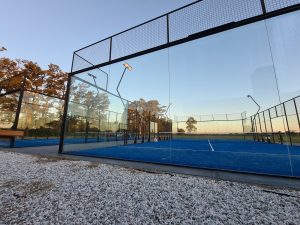
The FIP (International Padel Federation) states that a court must deliver “a uniform bounce of the ball”. To be able to deliver the appropriate level of rebound from the ball and avoid breakages, the glazed panels used for the back and side walls of the courts must be of the correct specification. The LTA, the governing body of tennis in Great Britain, states that they must be made with toughened (sometimes called tempered or safety) glass and be 10mm thick as a minimum for safety, though a 12mm thickness is preferred (TuffX supplies this as standard). For panoramic courts, 12mm is mandatory as the rebound on the ball is superior.
Many of the overseas manufacturers that make Padel court kits are known to use thinner glazed panels and/or skip the heat-soak process to save on costs and increase profitability. Heat-soaking is a process used to check for inferior quality glass, which is more prone to breaking. When buying your glass Padel court supplies, always check that they are 12mm thick and have been heat-soaked.
Whilst it may seem like good financial sense to take a risk and choose cheaper glass, you must factor in the cost of replacement panes and of resulting court downtime if one breaks.
Learn more about when heat soaked glass is required
The advantages of using UK-based businesses for Padel court supplies
It is usually more cost-effective and ecologically sound if you buy glass Padel court supplies that have been manufactured in the UK. The panels also tend to be of a higher quality too.
- Quality control – When buying glazed panels from a UK manufacturer, you can have confidence that they are made to British standards. Every panel must comply with BS EN 12150, the standard for safety glass. Heat-soaking is also under strict quality control in the UK and must comply with BS EN 14179. This ensures that the panels are free of impurities which means they are stronger and more durable, thereby reducing the likelihood of breakages and court downtime.
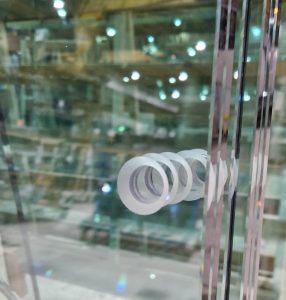
- Measurement – Whilst a 3m x 2m pane of toughened glass might seem universal, the precision of where holes are positioned within it can make a huge difference to how robust they are. If they don’t perfectly align with the frame, it can cause too much stress on the pane which may cause it to break when gameplay gets heated. This can be made worse by the frames adjusting slightly over time. By purchasing bespoke panels with the exact hole positioning measured whilst the frame is in situ, it will have a better fit. This will avoid the possibility of mechanical overstress, which can lead to breakages.
- Speed of delivery – Most Padel court kit manufacturers are based in Spain or China. The cost of shipping a single replacement glazed panel is expensive. It is also a long process, as it can take six to eight weeks to have a replacement panel shipped. This can result in a court being out of action for a long period, costing thousands of pounds in lost revenue. By ordering a replacement panel from a UK-based manufacturer, replacements can be made and installed much faster. With TuffX, a replacement can be supplied within just 3-5 days, reducing any court downtime to an absolute minimum.
- Sustainability – A typical Padel court requires 108 square metres of glazed panels to cover the necessary playing area, which weighs around 3.2 tonnes. Shipping this from China, where many Padel court kits are manufactured, generates around 1.5 to 2 tonnes of CO². It must also be transported over land by HGV, further increasing the panels’ carbon footprint. By choosing a UK manufacturer, the distance the panes are transported is much shorter, drastically reducing the amount of CO² generated. Furthermore, having a low-carbon supply chain for your Padel court supplies can often be a deciding factor in securing planning applications for new courts.
- Transit damage – By using a specialist UK-based supplier like TuffX for your glazed panels, the likelihood of damage during transit will be significantly reduced. This because glass suppliers will have specialist systems and processes in place to protect the panels during transit and installation.
Delivering the best return possible
As more tennis clubs, Padel clubs, and court operators try to stake their claim in the Padel gold rush, there will be those that strike it rich and those that struggle to get a payoff.
Courts that don’t offer a consistent rebound will affect players’ enjoyment of the game, and subsequently this will affect where they choose to play it.
Getting good quality Padel court supplies first time around is more likely to give a great first impression to new players and deliver a consistent game experience, resulting in more demand for court time.
Working with a UK-based glass manufacturer is the best way to deliver a premium game experience and keeps your Padel courts up and running and delivering good returns.
Want to learn more about the benefits of using a UK-based supplier and get a quote for your Padel courts? Speak to TuffX’s expert team today. Call 0345 3400 200 or email [email protected]
Resources
TuffX Products
Other resources
British Standard for toughened glass