Padel court enclosures have balls hitting them and people falling into them many times a day. This naturally leads many people to ask about how strong the glazed panels within them are, and the engineering that goes into them.
We will use this blog to explain why the glass is unlikely to break, and the circumstances in which they would be most likely to break.
Key Takeaways
- Padel court glass should be 10mm as a minimum for safety, though a 12mm thickness is preferred
- Toughened glass that has been heat soaked (a process which checks for impurities) is less likely to break
- Breakages are usually related to structural stress and impacts from sharp objects rather than people falling onto the glass or hitting it with a racket
 What type of glass is used in Padel Courts?
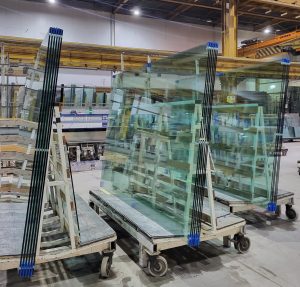
To be able to deliver the appropriate level of rebound from the ball and to avoid breakages, the glazed panels used for the back and side walls of the courts must be of the correct specification. They must be made with toughened (also called tempered or safety) glass, which is four to five times stronger than a standard pane.
The LTA, the governing body of tennis in Great Britain, specifies in its guidance the appropriate thickness should be 10mm as a minimum for safety, though a 12mm thickness is preferred (this comes as standard from TuffX). For panoramic courts, 12mm is mandatory, as the rebound on the ball is superior with thicker panes.
Download a datasheet about Padel court glass
Does the glass often break in a Padel court?
Whilst the panes are made of a special toughened glass, which significantly reduces the likelihood of breakages, they can and do break. However, the circumstances that see them break are usually quite different from what people expect.
Breakages are usually down to three key factors: the quality of the products used, structural stress (rather than direct impacts) on the panes, and unlikely incidents that can occur post installation.
What effect does heat soaking have on glass quality & durability?
Whilst toughened glass is incredibly strong and does not break easily, it is less likely to break if it has been through a process called heat soaking, which is a quality control process.
It is possible for microscopic impurities to get trapped in a pane during the manufacturing process. Over time, these tiny particles expand, increasing the internal tension. This can cause panels to break, even without anything touching them.
To reduce the likelihood of this happening, they go through a process called heat soaking, whereby the pane is heated to around 290°C and kept at this temperature for a prolonged period. Any panes with impurities will break during the process, meaning that any that remain intact are flawless. It’s therefore advisable to only buy glazed panels that have been heat soaked, as they’re less likely to break.
Read about when heat soaked glass is required
Do breakages usually happen during transportation & installation?
Transporting and installing the panels seems like an obvious way to break them, as they get jostled during the process. However, the process rarely causes immediate breakages (unless they receive a blow hard enough). Breakages usually happen at a later point in time.

Edge damage – Whilst toughened glass is much less likely to break during transportation and installation than standard glass, if the edge of a panel is chipped slightly during shipping or installation, it creates a micro-fissure. When installed within a court, the panels constantly receive impacts of differing severity which can cause the micro-fissure to grow into a larger crack. Eventually this crack grows to the point where a blow to the pane can cause it to break.
Mechanical overstress – If a panel is not fitted properly in a Padel court’s metal frame, for example the bolts are overtightened, it cannot flex in high winds or when it is hit with something. This creates mechanical overstress and can result in it breaking. This is especially common in cheaper court kits where the metal frame and holes in the panels aren’t perfectly aligned. Bolts are then forced into the holes which create a permanent stress on the pane which can cause it to break.
How can padel court glass break post installation?
Whilst you might imagine that hitting a glazed pane hard with a racket might break it, in most circumstances that isn’t the case. It’s a specific and unique type of stress on the glass that will cause it to break post installation.
- Sharp object impacts – Toughened glass is designed to withstand impacts from objects with a relatively large surface area, like a ball or player’s shoulder, by absorbing the energy. However, if it is hit hard with a very sharp point – for example the claw of a diamond ring, or the corner of a watch – it can break through the panels’ outer ‘skin’ and change its internal tension, causing it to break.
- Thermal stress – When a standard pane is affected by temperature imbalance – for example one half is in full sun, and the other half is in the shade – a difference of just 30°C can cause it to break.
Good quality toughened glass panes would need a temperature imbalance in excess of 200°C to be affected. However a poorer-quality product, or a panel affected by edge damage or mechanical overstress would have a reduced tolerance to thermal imbalance.
If a panel experiences thermal stress and more than one of the above breakage factors at once, it is much more likely to break than with a single breakage factor.

Summary
As we’ve explained, the glazed panels in a Padel court are very tough and durable, but given certain circumstances they can break. The best way to avoid breakages is to buy good quality glass, and avoid excessive handling and transporting panes long distances. However, this can be difficult to avoid if the glass is bought as part of a kit and shipped from manufacturers in China or Spain.
If the glazed panels are made in the UK, it will be easier to control the product quality, and to buy panes that have been heat soaked. It’s also easier to get bespoke panes, which will ensure the panels fit snugly in the enclosure. This will avoid mechanical overstress and allow the panels to flex without breaking, making them likely to last much longer.
To speak to the TuffX sales team about replacement Padel court glass panels or buying panels for multiple courts, simply contact us by completing our enquiry form and our team will be in touch or you can email [email protected] or call 0345 3400 200.
Resources
Tuffx Products
Other resources