 The Padel Gold Rush
The speed at which Padel is growing in popularity as a sport could be considered a global phenomenon. It has been called a ‘gold rush’ by some because the demand for courts is consistently outstripping supply around the world. As a result, the quality and robustness of Padel court glass and the issues related to court downtime are increasingly of importance to operators and clubs.
The number of courts has been growing by around 43% each year since 2016. In the UK alone, there has been more than a threefold increase in UK Padel participation in just one year
Court occupancy rates tend to exceed 85% and opening hours at some clubs are being extended to 6am-1am to meet the demand.
Given how few courts the UK has, compared to countries like Spain which now has more Padel courts than tennis courts, there is a consistent and growing demand for court space.
As the demand is by far outstripping supply, most deliver good returns quickly, even though creating Padel courts does involve a significant upfront investment.
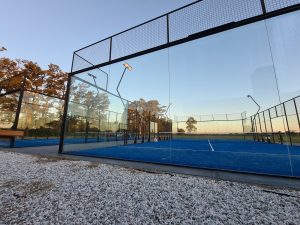
Padel Court Glass Panels
Given the nature of the sport, there will constantly be balls rebounding, rackets hitting and people falling against the glass panels in a Padel court.
To be able to deliver the appropriate level of rebound from the ball and to avoid breakages, the glass panels used for the back and side walls of the courts must be of the correct specification. They must be made with toughened (also called tempered or safety) glass, which is 4-5 times stronger than standard glass.
The LTA, the governing body of tennis in Great Britain, specifies in its guidance, that court glass should be 10mm thick as a minimum for safety. Though a 12mm thickness is preferred – and is mandatory for panoramic courts – as the rebound on the ball is superior with thicker glass.
Padel Court Kit Quality
At present, most of the Padel courts in the UK are built using kits, usually imported from Spain or China, which can take six to eight weeks to be shipped to the UK. However, there are known issues with the quality of these kits.
- Vibration – Cheap kits often use thinner steel frames or lower grade anchoring systems. This means that when a ball hits the glass, the whole structure vibrates creating a noticeable shuddering noise. This makes the court appear low-grade, and also puts the glass being held by the frame under additional stress, making it more likely to break.
- Corrosion – As Padel is incredibly popular in Spain, most court kits are designed for the Mediterranean climate. Subsequently, many don’t have the anti-corrosion coatings needed for the UK’s wet weather. Rust can start to appear within less than two years, causing metal expansion which changes the amount of pressure on the glass panels and can lead to it breaking.
- Inferior Glass – Many of the manufacturers that make Padel court kits are known to use thinner glass panels and/or skip the heat-soak process to save on costs and increase profitability. Heat-soaking is the process of putting glass panels into a specialized oven after tempering and heating them to approximately 290°C for between two and four hours. This forces any impurities in the glass to expand, which breaks the glass so it cannot be used. Any glass which does not break during the process can be considered free of impurities and is therefore of a better quality.
NB: Shipping the glass from China, where many Padel court kits are manufactured, generates around 2 tonnes of CO².
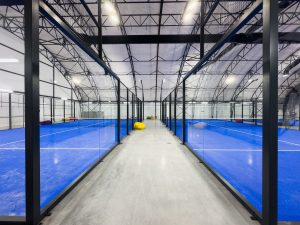
Padel court with lines and net indoor
Toughened glass breakages
Whilst tempered glass is incredibly strong and does not break easily (it is significantly more likely to break if it hasn’t been heat-soaked), it can happen.
There are five key ways in which toughened glass can break:
- Glass impurity – It is possible for microscopic impurities to get trapped in the glass during the manufacturing process. Over time, these tiny particles expand increasing the internal tension in the glass. This can cause panels to break, even without anything touching the glass. The process of heat soaking significantly reduces the likelihood of this happening.
- Edge damage – If the edge of a panel is chipped slightly – perhaps during shipping or installation – it creates a micro-fissure. When installed within a Padel court, the glass panels constantly receive impacts of differing severity which can cause the micro-fissure to grow into a larger crack and eventually break.
- Mechanical overstress – If a glass panel is not fitted properly in a Padel court’s metal frame, for example the bolts are overtightened, it cannot flex in high winds or when it is hit with something. This can result in it breaking. This is especially common in cheaper kits where the metal frame and holes in the glass aren’t perfectly aligned. Bolts are then forced into the holes in the glass which creates a permanent stress on the glass which can cause it to break.
- Sharp object impacts – Toughened glass is designed to withstand impacts from objects with a large surface area, like a player’s shoulder, by absorbing the energy. If it is hit hard with a sharp point – for example a diamond ring, or the corner of a gold watch – it can break through the outer ‘skin’ of the glass and change the internal tension of the glass, causing it to break.
- Thermal stress – When a standard pane of glass is affected by temperature imbalance – for example one half is in full sun, and the other half is in the shade – a difference of just 30°C can cause it to break. Good quality toughened glass would need a temperature imbalance in excess of 200°C to be affected. However poor quality tempered glass, or a panel affected by edge damage or mechanical overstress, would have reduced tolerance to thermal stress.
NB: If a glass panel experiences more than one of the above breakage factors at once, it is more likely to break than with a single breakage factor.
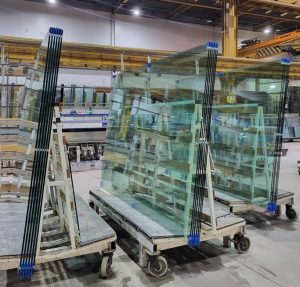
Padel Court Glass Replacements
If the glass pane in a Padel court kit is broken it creates a series of issues. Court downtime is expensive. For every hour that a Padel court is not in use, it costs the operator/club money. It also encourages players to find an alternative court to play on, making them less likely to return to their original club.
As most Padel court kit manufacturers are based in Spain or China, the cost of shipping a single replacement glass panel is expensive. It is also a long process, as it can take six to eight weeks to have a replacement panel shipped. This can result in a court being out of action for a long period, costing thousands of pounds in lost revenue.
UK-based Padel court glass supplier
Whilst a complete Padel court kit may seem like an obvious and cost-effective way to set up, it can be a false economy.
Buying UK-made glass panels to install within a new Padel court or to replace broken ones is usually more cost-effective, ecologically sound, and the panels tend to be of a higher quality.
- Quality control – When buying glass panels from a UK manufacturer, you can have confidence that they are made to British standards. Every panel must comply with BS EN 12150, the standard for safety glass. Heat-soaking is also under strict quality control in the UK and must comply with BS EN 14179. This ensures that the glass panels are stronger and more durable, which will reduce the likelihood of breakages and court downtime.
- Measurement – Whilst a 3m x 2m pane of toughened glass might seem universal, the precision of where holes are positioned within it can make a huge difference. If they don’t perfectly align, it can cause too much stress on the glass which may cause it to break when gameplay gets heated. With mass-produced kits, the hole positioning is less likely to be 100% accurate than bespoke panels made to order by a UK-based specialist. This will ensure that the panel has a perfect fit and avoids the possibility of mechanical overstress.
- Speed of delivery – By ordering a single glass panel from a UK-based manufacturer, replacements can be done much faster. With TuffX, a replacement glass panel can be supplied within 3-5 days, reducing any court downtime to an absolute minimum.
- Branding – Most good manufacturers of Padel court glass panels in the UK will offer screen printing, enabling the courts to be branded. This makes courts look more prestigious and increases the exposure players get to the club’s brand, making it more memorable and raising its profile among keen players and during tournaments.
- Panoramic – If you want to use your Padel facilities to be considered ‘premium’ and an ideal location for tournaments, panoramic courts are a must-have. By having continuous glass panels, rather than glass integrated into a steel frame with posts, spectators get a much better, uninterrupted experience. It is much more practical to have these panoramic glass panels made in the UK and transported to your site by a glass expert, than shipped from overseas as standard cargo.
- Sustainability – A typical Padel court requires 108 square metres of glass to cover the necessary playing area, which weighs around 3.2 tonnes. Shipping the glass from China, where many Padel court kits are manufactured, generates around 1.5 to 2 tonnes of CO². It must also be transported over land by HGV, further increasing the glass panels’ carbon footprint. By choosing a UK manufacturer, the distance the glass is transported is much shorter, drastically reducing the amount of CO² generated. Furthermore, by using a UK-based supplier like TuffX, it is also possible to choose whether to use low carbon toughened glass for your Padel courts. This has a carbon footprint which is 42% smaller than standard toughened glass. Clubs and operators who can demonstrate they have a low-carbon supply chain can often be more successful with securing permission for their planning applications.
- Transit damage – By using a UK-based glass supplier like TuffX, the likelihood of the glass panels being damaged during transit will be significantly reduced. They will have specialist vehicles, systems and processes in place to reduce the likelihood of edge damage, making the requirement for a replacement panel less likely.

DElivering the best return possible
As more tennis clubs, Padel clubs, and court operators try to stake their claim in the Padel gold rush, there will be those that strike it rich and those that struggle to get a payoff.
Courts that don’t offer a consistent rebound from the glass panels will affect players’ enjoyment of the game, and subsequently this will affect where they choose to play it.
Getting the quality right first time around is more likely to deliver a great first impression to new players and a consistent game experience, resulting in more demand for court time.
Working with a UK-based supplier is the best way to deliver a premium game experience and keep your courts up and running and delivering good returns.
Want to learn more about the benefits of using a UK-based supplier and get a quote for your Padel courts? Speak to TuffX’s expert team today on 0345 3400 200.