Despite only having been invented around 100 years ago, toughened glass has been growing in popularity as a building material ever since.
As architects find interesting new ways to use it to deliver elegant aesthetics and sustainability sees people want to make better use of natural light to reduce energy bills, we will inevitably see its use increase further. This guide was created to help you understand what toughened glass is and the benefits of using it.
Key takeaways
- Key applications for standard toughened glass include external envelope, internal partitions, structural supports, and sanitary, high moisture environments
- The key applications for laminated toughened glass are overhead glazing, safety barriers, and load bearing elements (e.g. walk-on rooflights)
- Standard and toughened pane of glass can both look and weigh exactly the same, but behave very differently
- Toughened glass has nearly double the soundproofing capabilities of a normal pane of glass of the same thickness
- Toughened glass gives better UV (ultra-violet) protection from the sun’s rays than a standard pane of glass
 What is Toughened Glass?
To appreciate what toughened (also called tempered or safety) glass is, you need to understand how it is manufactured.
A standard pane of glass is heated to approximately 620°C, which causes it to soften. The glass is then cooled quickly using high-pressure blasts of air, a process that’s called quenching. The inside core of the glass pane shrinks as it cools, pulling and compressing the now-rigid outer surfaces even tighter, changing the internal mechanical tension of the pane, which toughens it.
This new internal structure makes the glass five times stronger and also changes how it responds when it breaks. Rather than snapping into large pieces like normal glass, it now breaks into small cubes.
Types of toughened glass
There are two types of toughened glass, standard and laminated.
- Standard toughened glass is simply a single pane of glass that has been through the process of tempering and quenching.
- Laminated toughened glass has at least two panes of toughened glass with a laminated interlayer (a special type of transparent plastic sheet) in the middle. This holds the two panes of glass in place, and if the glass panes were to break, the broken pieces would still be held in place by the interlayer.
Explore our toughened glass range
Architectural applications for toughened glass
There are seven key applications for toughened glass. These are:
- External envelope: Curtain walling and high-performance facades.
- Overhead glazing: Glass roofs, atriums, roof lights, canopy systems, and conservatory roofs.
- Internal Partitions: Frameless office dividers, meeting rooms and glass doors.
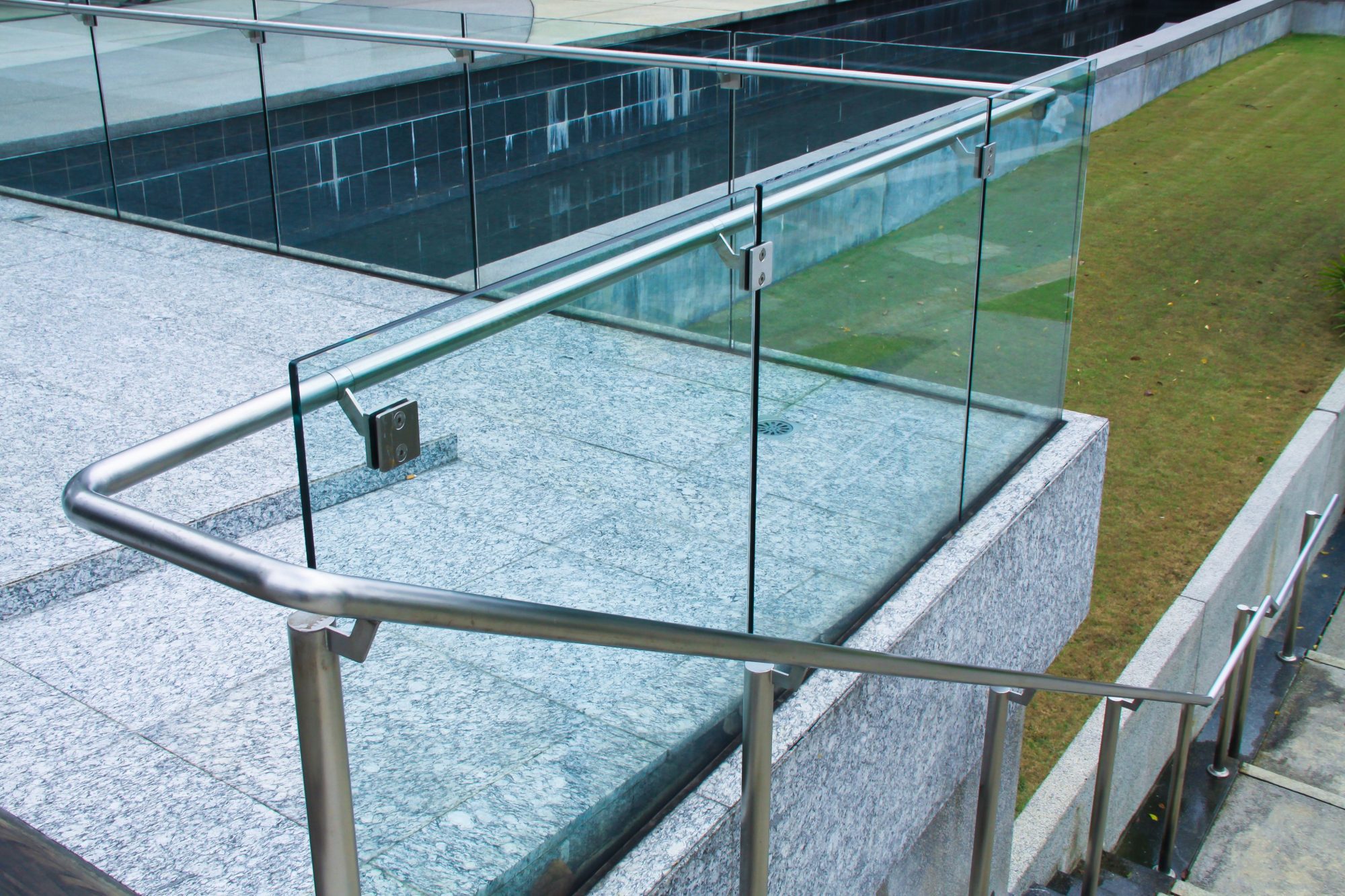
- Safety barriers: Frameless balustrades, Juliet balconies, and lift shaft enclosures.
- Load-bearing elements: Glass stair treads and walk-on floor panels, and walk-on rooflights.
- Structural supports: Glass fins and large frameless, bolted-together glazing systems.
- Sanitary & High Moisture Environments: Frameless shower enclosures, wet room screens, and steam room glazing.
Building regulations related to toughened glass
Due to its durability and the way in which it fractures, the use of toughened glass is mandated in certain circumstances in the United Kingdom. The Building Regulations’ Approved Document K states that it must be used in the following situations.
- Doors and side panels: Any glazed doors, glass panels within doors, or side panels within 300mm of a door edge that are below 1500mm from floor level.
- Low-level glazing: It should be used in all glass walls, partitions, or windows situated less than 800mm from the floor, which would include large ground floor storefront/office windows
- Guarding: Any glass protective barriers where people could easily fall from height (more than 600mm for homes, 380mm for commercial buildings), for example floor to ceiling windows on upper floors. It should also be used when it is likely to be leaned on, so that it can easily support any imposed weight or pressure, for example for glass balustrades. If the design is frameless and doesn’t have a handrail, toughened laminated glass must be used to maintain a barrier, should a breakage happen.
- Overhead installations: Overhead glazing in atriums, rooflights, and roof lanterns must have toughened glass. If the glazing is more than 5 metres above the floor and/or is above a public space, atrium, or high-occupancy area, it must be laminated glass. This is to reduce the risk of any injuries in the very unlikely event that an overhead glass panel were to break and glass potentially to fall from the ceiling.
- Structural Floors: Toughened laminated glass must be used for glass steps or walk-on glass floors. These are usually triple-laminated.
- Wet Rooms and Bathrooms: Toughened glass is mandatory for shower enclosures and bath screens. Due to the high risk of slipping in confined wet environments, the glass must be able to withstand a significant bodily impact without breaking into dangerous pieces.
NB: When using toughened glass for doors, office partitions, and shopfronts, it must be manifested (frosted patterns, dots, or logos must be etched at two specific heights: between 850mm to 1000mm and 1400mm to 1600mm above the floor) to prevent people from accidentally walking into the glass. The Part Q Regulations, which relate to security, can also advise on the use of toughened glass.
See examples of toughened glass in real projects
Benefits of toughened glass
There are eight key benefits of using toughened glass:
- Appearance: It stands to reason that toughened glass is stronger than standard glass. In reality though, it can be hard to appreciate that a standard and toughened pane of glass can both weigh exactly the same, look the same (excluding kitemarks) and be the same thickness, but behave very differently. Although toughened glass looks the same, it is five times stronger and responds to impact in a completely different way, usually withstanding a heavy impact without any damage.
- Acoustic performance: The internal tension that makes toughened glass stronger also affects its acoustic insulation properties. It has nearly double the soundproofing capabilities of a normal pane of glass of the same thickness. This makes it ideal for room dividers, or for creating meeting rooms.
- UV filter: Toughened glass gives better UV (ultra-violet) protection from the sun’s rays than a standard pane of glass, effectively acting as a barrier against most UVB rays. Toughened glass has the equivalent of an SPF (sun protection filter) of 16. Not only does this give protection to people living and working within buildings, it also gives a property’s interior, furniture, fabrics and artwork more protection from sun-bleaching.
- Thermal shock resistance: Thermal shock is a common issue with glass. It occurs when a pane is heated and cooled at the same time, for example with heavy shade from a tree on one side and direct sunlight on the other, which can cause it to crack. Standard glass can only withstand a temperature difference of around 30-40°C. Toughened glass, on the other hand, can withstand a temperature difference of as much as 250°C on a single pane, making thermal shock much less likely.
- Durable: Over time, a standard pane of glass is susceptible to deterioration, either through it weakening over time, or a build up of micro-scratches making it look tired. Toughened glass is less likely to deteriorate and to suffer surface damage, which means it looks better and newer for longer.
- Damage resistant: All too often, standard glass panels are broken during installation. Damage usually occurs at the corners or edges which results in unsightly chips or the pane breaking completely. Toughened glass panels are much more resistant to damage and can withstand much heavier impacts like collisions, or kicks/hits, even at corners and edges, making it much easier to transport and install.
- Safer: Whilst it’s much harder to damage toughened glass, if it were to break, the likelihood of causing injury to people or damage to property is very low. When a standard glass pane breaks, it breaks into long sharp pieces that often result in cuts. With standard toughened glass, if a pane breaks it will form into small cubes which have a small surface edge. This makes it unlikely to inflict heavy damage. With laminated toughened glass, if a break occurs, the small cubes of glass that are produced are held in position by the laminated interlayer, making it even safer.
- Mounting versatility: Because toughened glass is significantly more robust than standard glass, it can be secured using a wide variety of hardware. Any required holes or cut-outs are made prior to the tempering/quenching process, allowing the glass to be bolted directly to a structure without the need for a bulky perimeter frame. This versatility enables it to be used to create an “all-glass” aesthetic for things like glass balustrades, glass atriums, and architectural fins.
Explore TuffX’s range of toughened and toughened laminated glass

Selecting the right toughened glass product for your project
At TuffX, we understand the multiple benefits that toughened glass offers to architects and builders, giving them the freedom and flexibility to create attractive, bright, airy spaces that are practical, and compliant with building regulations. We also know which toughened glass products are best for different situations and which thickness is appropriate and when.
To learn more about our range of toughened glass products and our bespoke options, contact our expert team for guidance on choosing the right solution for your project. Or call on 0345 3400 200.
Resources
TuffX toughened glass products
- Glass balustrades
- Walk-on glass
- Walk-on glass rooflights
- Conservatory glass
- Glass partitioning and screens
- Bespoke glass doors and entrances
- Glass stair treads
- Glazed canopies
Building regulations
- Approved Document K – This relates to protecting building users from falling, collision and impact in and around the building.
- Approved Document Q – This relates to optimising security in homes.